
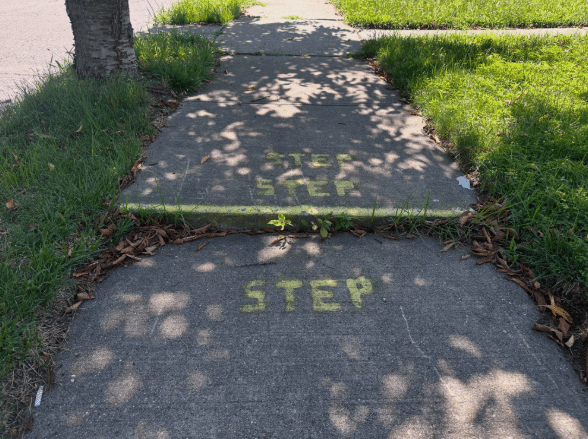
Attorneys often call a short flight stairs expert witness when a customer falls on a step that looked harmless. In fall cases it is often the opposite. Customers expect a full flight of stairs to announce itself. A single step up to a raised dining section, a two-riser drop onto a restaurant patio, or a step at a grocery store entrance or bakery counter often does not.
ASTM F1637, the Standard Practice for Safe Walking Surfaces, defines a short flight as three or fewer risers and recommends avoiding them where possible. When a short flight cannot be avoided, the question in litigation becomes simple: did the owner make the change in level obvious to a reasonable person walking through the space?
This article covers why short flights cause falls in restaurants, grocery stores, and other businesses open to the public, which codes and standards apply, and what evidence an attorney should secure early.
Why people miss one or two steps
A full flight of stairs is a strong visual signal. Handrails, a stairwell, and repeated nosings tell the brain to slow down and look. A short flight sends a weak signal, and sometimes none at all.
The common failure points are:
- Same color and pattern above and below the step. Carpet, tile, or concrete that runs continuously over the edge makes the riser blend into the floor.
- Descending. On the way down, a person sees mostly the top of the tread. The drop below the nosing is hard to judge.
- Distraction by design. Short flights often sit at entrances, display areas, and room transitions where people look ahead, not down.
- No handrail. Without a rail, there is no cue that a step exists and nothing to grab when the foot misses.
- Poor lighting or glare. Shadows and bright backlighting hide edges.
Codes and standards that apply
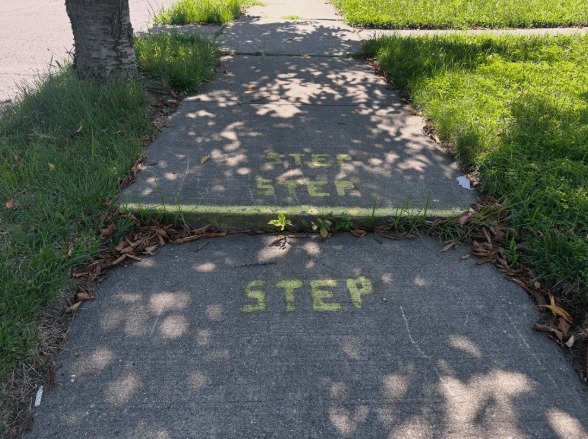
No single document governs every short flight. The applicable code depends on the jurisdiction, the occupancy, and when the space was built or altered. These are the ones that come up most often.
| Source | What it says about short flights |
|---|---|
| ASTM F1637 (Safe Walking Surfaces) | Defines short flights as three or fewer risers. Recommends avoiding them or converting to a compliant ramp. Where they remain, calls for visual cues that make the change in level apparent. |
| International Building Code, Section 1003.5 | Changes in elevation under 12 inches in a means of egress must be sloped surfaces or ramps. A single riser, or two risers and a tread, is allowed only where accessibility is not required, with a tread at least 13 inches deep and at least one handrail within 30 inches of the centerline of the egress path. |
| NFPA 101, Life Safety Code, Chapter 7 | Changes in elevation of 21 inches or less in a means of egress must be made by a ramp or stair. The code also recognizes that small changes in level are easy to overlook and must be made apparent. |
| CPSC, Guidelines for Stair Safety (1979) – Technical Publication | Cautions against single-riser stairs. Often cited to show the hazard has been documented for decades. |
The IBC exception is narrow and specific: 13-inch tread, a handrail within 30 inches of the path. Many short flights in older retail and hospitality buildings meet neither condition. That gap between what the code allows and what was built is often where a case turns. Local adoption and amendments vary, so the edition in force at the time of construction or alteration must be confirmed.
Restaurants, grocery, and retail: compliant is not always the same as safe
Restaurants and grocery stores may often contain short flights: raised booths and dining platforms, patio and bar transitions, entry vestibules, loading-area steps near customer paths, and older buildings with sunken or split-level floors. Defendants often argue the step met code when it was built. Code compliance is a minimum, not a defense to every claim.
A business owes customers reasonable care for conditions it knows about or should know about. These spaces are designed to pull attention away from the floor: menus, displays, hosts, and other diners. Dim dining-room lighting, wet entry mats, and carts or trays in hand make a missed step more likely. An owner that watched customers use a short flight every day, in those conditions, had a foreseeable hazard whether or not the original code required more.
How a short flight stairs expert witness evaluates a fall
My analysis focuses on two questions: was the hazard recognizable, and was the fall foreseeable?
- Recognition. Would a reasonable owner or operator have identified the step as a hazard? I look at contrast, lighting, sightlines, signage, handrails, and whether the step sits in a high-traffic path.
- Foreseeability. Was there notice? Prior incidents, complaints, near-miss reports, maintenance requests, and inspection records all show what the owner knew.
- Feasible controls. Could the hazard have been eliminated or reduced? Options include a ramp, contrasting nosing flush with the edge, a handrail, better lighting, or a rail or planter that redirects traffic.
- Standard of care. I compare what was done against ASTM F1637, the adopted building code, NFPA 101, and accepted safety management practice.
Evidence attorneys should secure early
Short-flight conditions change fast. Owners repaint nosings, add rails, or change lighting after an incident. Secure these before they are gone:
- Photos and video of the step from the direction of travel, at eye level, ascending and descending
- Measurements of riser height, tread depth, and handrail position
- Lighting levels at the time of day of the fall, including dimmed dining-room settings
- Floor finish and color on both levels, plus any nosing or edge marking
- Mats, displays, signage, or furniture placed near the step
- Surveillance video, preserved under a written hold request
- Building permits, plans, and the code edition in force at construction or remodel
- Prior incident reports, customer complaints, and maintenance or inspection records
- Footwear the injured person wore
Early measurements and photos often decide whether the case can be evaluated at all.
About the author
Bryan Netherland, CSP, CSHO, ARM, WACH is the owner of Seek Safety Consulting. He has more than 15 years of EHS leadership experience across varying industries and teaches occupational safety as an adjunct professor. He serves as an expert witness for plaintiff and defense attorneys nationwide in premises liability matters, with a focus on hazard recognition and risk foreseeability.
Have a stair or single-step fall case? Contact Seek Safety Consulting to discuss the facts. Initial case reviews help you decide early whether the condition supports your theory.
Related: Premises Liability Expert Witness